The Grand Palace – Thailand Part V
On the next day, I was on my own again, but thanks to the day with my friend, I felt much more confident than in the beginning. I knew I would just shake off all attempts to get me in a tuk tuk and go where I wanted. And this time, I knew where I wanted to go: The Grand Palace.

It was only a short walk away from my hotel but it involved crossing a big crossing without (useful) traffic lights, which was a challenge on its own at first. Once you get used to the fact that you have to be a little bold and just go when there’s a chance it’s fine. Of course I was approached by tuk tuk drivers, who even spoke German, again but this time I didn’t listen to their talks. I just walked on to the palace.
There, it was crazily full with tourists and unofficial guides who tried to sell their service. However, it became a little bit quieter inside the palace. I took my time to look at everything very closely and got lost in the story painted on the inner side of the palace walls.


The palace grounds also include a fashion museum showing the dresses worn by Queen Sirikit and an exhibition of regalia and it took me four hours to see everything.
Later, I went to the Siam Museum, which was very interesting, too. Since I went there after 4 pm admission was free! But even if you had to pay for it it’s certainly worth a visit. I learned much about the culture and history of Thailand. After this visit I didn’t feel that unfamiliar with everything anymore.
Shopping, Sightseeing, Sukiyaki – Thailand Part IV
Half a year has passed since I went to Bangkok and now I’m here again, this time for a conference. So many things happened in between and I was too busy to blog, but now I unexpectedly got some spare time and I take this as an opportunity to finally continue writing about my holiday trip to Thailand.
So, I think so far I only blogged about the first day and I’ll speed up a little from now on. The first day was the most exciting (and stressful) day anyways.
On the second day, I was happy to meet my Thai friend who took me by the hand and showed me around. I hadn’t met her for 4,5 years, but she hadn’t changed a bit since we said goodbye in Osaka. Because I knew her from Japan, we talked in Japanese the whole time, sometimes causing confused looks in some Thai people and a Japanese man who sat next to us in a restaurant, too.
First, we went to the weekend market for some shopping. It’s a huge market selling everything from clothes, accessories, souvenirs and much more. It’s so large, I probably only saw a fraction of the stalls. But there were many interesting and beautiful things to buy and the best about it: they were also quite cheap. Sometimes in the negative sense of cheap, but if you check your goods thoroughly for holes and other mistakes before buying, you can get some really nice things there.

In between shopping we had some refreshing smoothies and then went on to Jim Thompson’s House. It’s a complex of wooden houses built by the American architect and silk trader Jim Thompson.

In the evening, we ate sukiyaki. Despite originally being a Japanese dish, the Thai version of sukiyaki is hardly comparable to the Japanese, which consists of thin slices of beef, vegetables and tofu that are cooked in sugar and soy sauce. Instead, Thai sukiyaki was cooked in a light clear broth and included a greater variety of ingredients that were then dipped into some sauce like Japanese nabe or shabu shabu. Anyways, it was delicious 🙂 We also had emerald noodles and duck.

Afterwards, we walked a little more through the streets checking out the street stalls and had mango desserts. No need to mention they were super delicious too 🙂
Getting Fooled in Bangkok – Thailand Part III
Since I had to wait until I could change my room, I slept quite long the next morning. Bangkok certainly looked different by day as I checked the view of my room:
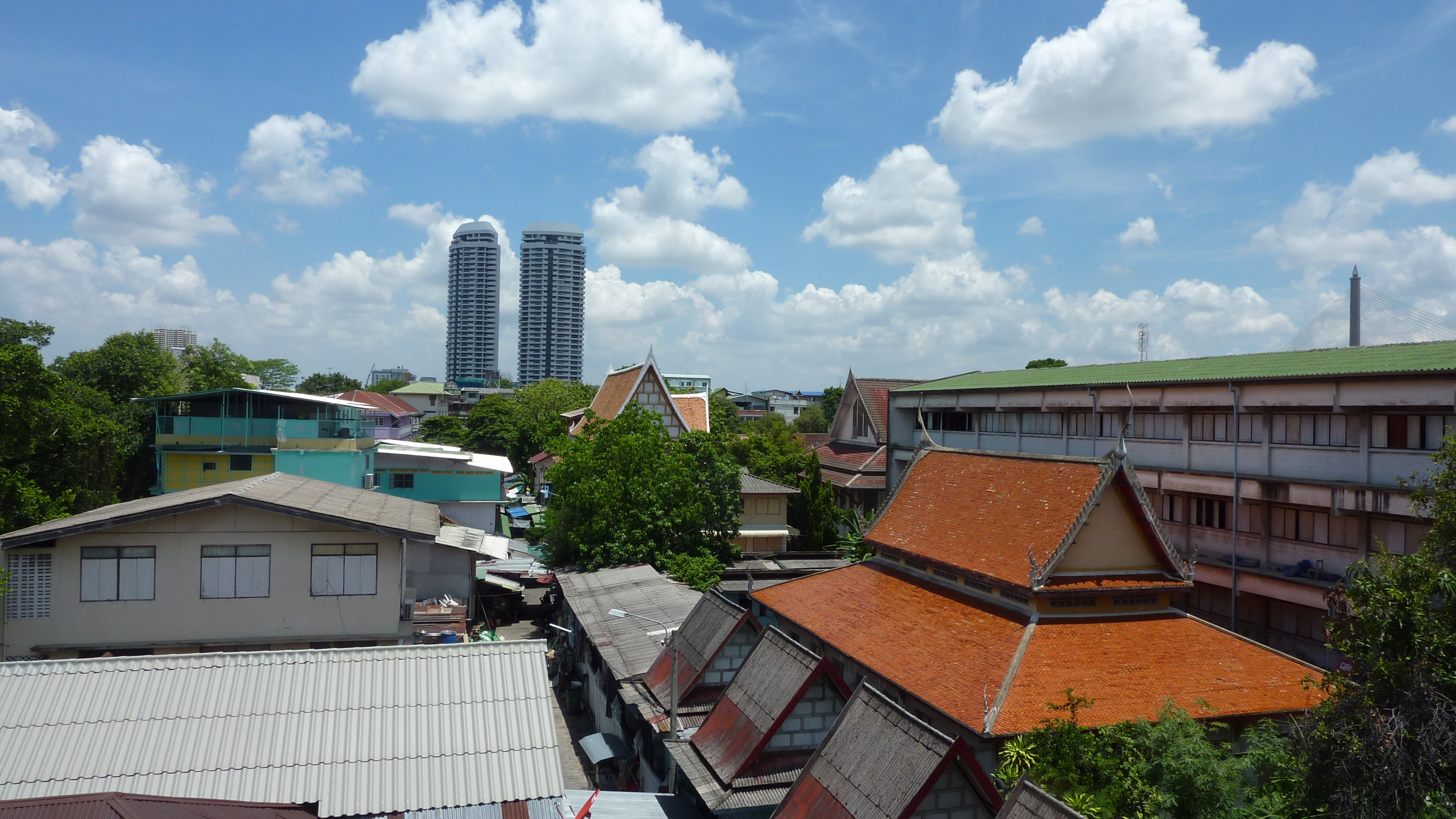 The blue sky with its happy little clouds and the bright roof tiles made a totally different impression than the night before.
But when I got into the bathroom I saw a big cockroach. It was lying on the back pretending to be dead, but when I wanted to throw it away it got up. So I had to kill it anyway… But I was kind of relieved, because a dead cockroach would have worried me more than a living… I mean, they survive everything, right? What would it mean if there was a dead cockroach in my room?!
It was almost noon when I finally got to move my room and then I went out to explore the neighborhood. As soon as I stepped out of the hotel, taxi drivers where approaching me. But I didn’t want to go anywhere, I just wanted to walk and so I turned into Khaosan road. It was almost empty and very quiet at this time. Only a few tourists were having lunch and I decided to get some food too before I would walk on.
 As I walked, I was approached by Tuk Tuk drivers every few meters. They were telling me that it was a Buddhist holiday and all temples would be closed but one which they could show me, but I had been warned about them before going to Thailand so I blocked all approaches and made my way to the Democracy Monument:
 There was a temple near the monument, but there weren’t any tourists or other people. While I was looking for the entrance a man walked up to me and started talking to me in English. He said he was an English teacher at a highschool near that temple and asked me questions like where I’m from etc. It seemed like he was just interested in talking English to a foreigner. He told me that the temple was closed because of a Buddhist holiday (I started to believe that it was one) and invited me to chat for a while. After some small talk he started to tell me about some places I should go and where better not to go, including tailors. He even marked the spots in my map and seemed really helpful, but in the end he guided me… to a Tuk Tuk! Oh no, I thought, but he had been so kind that I thought I couldn’t turn down his offer… After all, could I say I’ve been to Thailand without ever riding a Tuk Tuk? And the driver would charge only 1 Euro for two hours driving so it wouldn’t be a great loss, would it?
So I got on the Tuk Tuk and we went to the first stop, a small temple not far away. While the driver was waiting, I went inside.
 There was one monk meditating and one Thai who chatted with me. He told me that his wife was in hospital, because she was in labour and he came to the temple to pray for a safe birth. He also told me that because of the Buddhist holiday, tailors would give discounts on their clothes so that he could afford some very fine clothes that would be too expensive for him usually. He even mentioned the same tailor the English teacher had recommended.
I began to feel safe. Maybe I had been really lucky to meet that English teacher, I thought.
But then the drive with the Tuk Tuk turned into a tourist trap. It was exactly as I had been told: The Tuk Tuk drivers take you from shop to shop and hope that you buy something so they would get coupons for gasoline.
First, we went to the already mentioned tailor. Since I’ve been looking for a suit or costume for a while and haven’t been able to find one in Japan so far, I actually thought that I could get something tailored. The staff was friendly and I chose some cloth and cut. After I bargained and got a good discount, the tailor proceeded to measure me and I filled in the form to order, but when I wanted to pay it turned out that I couldn’t use my credit card although I had asked in advance if it would be possible to pay with a JCB card. Then the trouble began…
One sales person accompanied me to several ATMs so I could get some cash, but wherever we went, no ATM would accept my JCB. It wasn’t even possible to get money at a bank with my passport, so we returned to the tailor and I requested to cancel my order. The tailor said it wasn’t possible to cancel because I had already filled in the form and the company would think he deceived them if I would cancel now. Instead, he offered me to pay just a little amount of cash so he could give the order to the factory and pay the rest the next day when I would fetch my clothes. In the meantime, I could contact my bank and sort things out, he suggested. But I didn’t want to do that. I thought, once the clothes are made it would be very hard for me to pay if I couldn’t get more cash. Unfortunately, the tailor didn’t want to give in and offered me his mobile phone to call my bank immediately, which I tried, but I couldn’t reach anyone. Since he still didn’t want to give in, I asked to call my Thai friend for help. Luckily, we communicated in Japanese so the tailor couldn’t understand what we were talking about. I asked my friend if it really wasn’t possible to cancel my order anymore and she said it was, so I should insist on it. I was really relieved to hear that and told the tailor, that my friend also didn’t think I could get money from my bank after I’ve tried all means, and requested to cancel again. Finally, the tailor gave in and released me from this unpleasant experience…
But the Tuk Tuk driver wasn’t satisfied with the outcome. He drove me to another tailor and asked me to at least have a look so he could get his coupons. Well, I had a look but didn’t want to get into the same hassle again so I left after five minutes. What followed were a jewel and souvenir shop and a tourist agency, where I booked a day-trip to Kanchanaburi. It seemed like the whole tour was good for something at last… The Tuk Tuk driver still wanted to go on afterwards and show me more clothes shops but I had more than enough. I asked him to drive me back to the Democracy monument which he did. When I paid him he had a look at the small bag I got at the souvenir shop and asked how much I had paid. It was around 5 Euro, so he got pissed and just said “cheap”. And that was pretty much the end of the tour.
In the end, I had been driving around for almost four hours without any break and I was quite exhausted but I didn’t want to end my first day in Bangkok like this so I decided to continue walking for a little while. Unfortunately, I didn’t take the route I intended to and it took some time for me to notice my mistake and reorientate. Somehow I had ended up at the Ministry of Defence where a group of soldiers was pulling down the flag.
 Then I just wanted to return to my hotel but it wasn’t that easy to get there even after I found my current place on the map, because there were some big roads which could only be crossed at certain points so I had to go back and forth to find a way. Somehow I made my way back, took a shower and ate at the Indian restaurant a few meters away from my hotel. How glad was I that I would meet my friend the next day!
Arriving in Bangkok – Thailand Part II
Less than a week before my trip I realized that I still hadn’t planned anything else besides booking my flight and hotel because I hadn’t found the time, so I ordered a travel guide for Bangkok via amazon. I didn’t have time to read it either but felt kind of safe just to have it. Especially because it came with a map where I could mark my hotel. Everything else could come later…
The day before my departure I was at university all day. I hadn’t packed my stuff yet and wanted to do that when I came home in the evening but first there were some last mails to write. When I was finally prepared for my trip it was 2 o’clock in the morning and I would have to get up at 5:30 to catch my bus to Kansai airport.
 So I didn’t get much sleep but I managed not to oversleep and was on the bus on time. Everything went smooth at the airport, except that the lady at the check-in counter must have seen a German passport for the first time in her life… She looked at my passport like forever as if she thought it was fake. After a while she tried to read “Deu… Deuch…?” “Doitsu desu ne” (“It’s Germany”) I replied.
It was my first flight with China Airlines and just the day before I had talked with a friend who fights his fear of flying by using a service which informs him about problems on all flights so he could find out which companies often report problems and which don’t. He didn’t name China Airlines as one of those who don’t report problems that much… Luckily, I have no fear of flying. On the contrary, I usually enjoy it very much.
My first impression of the plane was that it looks a bit old and not as clean as I was used to. There was a bubble gum sticked to the seat in front of me… But this also speaks for the passenger flying before me and since its colour blended in perfectly with the plastic of the seat I thought that this is forgivable. Otherwise, I couldn’t complain about the service. The food was alright and the entertainment system up to date. I had to transfer in Taipei where I landed on time and continued my journey just a little later.
The flight from Taipei had already started delayed and there was a big bad weather front the plane had to fly around which delayed it even further. Most of the time, I was gazing out of the window. No matter how often I fly I’m still fascinated with watching the earth from above or the formations of the clouds and to watch a stormy sky out of a plane was especially exciting. I could see lightning in the clouds nearby which was really amazing 🙂
When we finally had to turn to Bangkok the plane finally got into some great turbulences. It felt like a rollercoaster ride and some people started to scream… At that time, I was listening to Leona Lewis’ “Trouble”. Oh, the irony.
Finally we landed safely, I got through the immigration procedure and got my luggage. The hotel had written on its homepage that it would be the easiest to go to the hotel by taxi and I decided to stick to that advice. I had printed the map the hotel provided as well but the taxi-driver didn’t seem happy with it. After a while he asked me if he could bring me to Khaosan road instead of the hotel because he wasn’t sure if the road of the hotel was broad enough for cars.
The taxi ride including highway fees and a surcharge, which the driver apparently was allowed to add, summed up to around 550 Baht (ca. 14 Euro) in the end. The driver told me where Khaosan road was and then I put my feet on Bangkok’s ground for the first time.
By that time, it was already dark. It was hot, but not as sticky as I expected. I was pretty exhausted and just wanted to reach the hotel as soon as possible. It took a while to orientate but finally I found my position on the map. Khaosan road looked very crowded and I thought it would be easier to walk through the parallel road which, according to the map, should lead me to the hotel too. This turned out to be a mistake…
The parallel road was narrow and dirty. Some unpleasant smells reached my nose and there were some malnourished cats. My wish to reach the hotel as soon as possible grew bigger… However, while the road I was following appeared to be just straight in my map it turned out to have some crossings so when I reached the first crossing I thought that I would have to turn left to get to my hotel. But it wasn’t there…
After some back and forth I returned to my starting point. I was thinking whether I should just walk through Khaosan road but it still seemed very bothersome and I decided to try the parallel road one more time. This time I walked past the crossing and finally, I somehow ended up near the end of Khaosan road. At least I knew that the hotel wasn’t far from there so I felt relieved.
Then a taxi driver asked me where I was going and asked me to show him my map. He pointed in the direction of my hotel. All I had to do was to cross the street and walk down a few more meters. While I was waiting for the traffic light to turn green, I was constantly asked for my goal by taxi and Tuk-Tuk drivers. At that time, I was still used to being polite and answer if someone asks me a question so I named my hotel and some drivers tried to get me on a ride even if my hotel was maybe 50 meters away…
So I was still waiting for the traffic light. And kept waiting… and waiting… By the time I started feeling stupid many people had passed me and ran over the street between cars and buses already. Being a good girl, I still thought that I should wait for the green light and after all, I surely was to slow to slip through the traffic with my luggage so I waited a little longer. I had pushed the button, hadn’t I? Yes, I had… Still no sign for changing lights. It began to dawn on me that these lights would never change. I had to look for a chance to run…
Somehow, I made it to the other side and learned my first rule for Bangkok: Traffic lights are optional! This rule was proved for validity many times during my stay and can count as being true 😉
Finally, finally, I reached my hotel. At the reception I was told that there were no more single rooms so I was given a double room for that night. I had to change rooms on the next day and couldn’t leave the hotel until then but that was fine with me. I intended to sleep longer the next morning anyways.
The hotel did have an elevator for luggage and if you didn’t fit in your bag you had to walk the stairs. Just kidding, you had to walk anyways 😉 My room was on the 5th floor, yay! The room itself was just as I had expected and as it looked at the pictures I had seen. It was clean but the bathroom smelled a little bit like sewage. It wasn’t much though, so it was bearable.
My last mission that day was to get some food and water from the 7-Eleven across the street. I managed to pick the spiciest meal available as my friends told me later: Some fried rice with pork and basil.
 It was tasty but really really spicy. After a few bites, my cheeks started to feel tingly! I had to take a few breaks in between to finish my first meal in Bangkok but no meal was as spicy afterwards. I guess it was a good primer for Thai food 🙂
Breaking the Habit – Thailand Part I
I realize that I have a lot to write about my recent trip to Thailand, so I’ll write this post in several parts. Hope you enjoy reading as much as I did travelling 🙂
Ever since my first stay in Japan I kept saying that I also wanted to travel other Asian countries more but due to a lack of time and money nothing of that sort happened during the six and a half years that have passed since then. Then in the middle of March this year I finally decided to travel. After all, I had been working and researching almost non-stop since January and needed a break. And thanks to all the work I even had enough money to actually go on a trip. I also thought that I need to visit an unknown place to break out of my usual thinking patterns. Japan had become familiar, I had become somewhat Japanese and I wanted to get to know other countries before I became a victim of the “safe Japan dangerous overseas” belief.
So, I knew I wanted to travel Asia but Asia is pretty big so where should I start? China? But the pollution… Korea? I definitely want to go but it’s so close (geographically and culturally?) I felt I could visit easily anytime. This time, I wanted to go a bit farther and so I decided to follow up on my promise to visit my friends in Thailand. I hadn’t met some of them for five or six years and I remember how we said Goodbye in Osaka telling ourselves that we would meet again one day…
I contacted one of my Thai friends to ask for advice on hotels and started searching for flights. I could manage to go a few days before Golden Week, one of Japan’s busiest travel seasons, so I got a very cheap flight with China Airlines. From my friend I had heard that the area around Khaosan was a safe place to stay and looked for hotels in that area. Khaosan is Bangkok’s backpacker’s ghetto, a very fitting name as I should learn later, but I am not a backpacker and didn’t want to stay in a dormitory which would be the cheapest option. However, after scanning several travel websites I found a hotel which offered single rooms with private bathrooms at a dormitory’s price. Opinions on the quality varied greatly but you get what you pay for and I didn’t expect anything more than a clean, lockable room and my own bath. No amenities, no service. The fact that the hotel offered air condition seemed like an exorbitant service already! What more could I wish for?
So I booked one week in Bangkok, a place I knew nothing of except what this song told me:
(You knew I couldn’t post about Bangkok without mentioning it, didn’t you?)
la farfa – A Magazine for Big Japanese Girls
When I heard that the first fashion magazine for big ladies in Japan would be published I was very excited. It smelled like revolution. Wasn’t this a sign for a change? For an end to magazines only displaying super thin models and a call for fashion designers to offer clothes in bigger sizes?
How disappointed was I when the magazine appeared in stores at the end of March. I got me a copy in a bookfirst in Kobe where it was positioned right below the special issue of a magazine calling to “Loose weight beautifully!” with “easy exercises with which you will never gain weight again”. It was like a punch in the face of comedian Watanabe Naomi who posed on the first cover of la farfa.
 I wonder how a Japanese “Ms Chubby” or “pocchari-san” will feel when she looks for la farfa and finds diet messages just on top of it. Maybe she should try another diet instead of embracing her body to make the best of it? Maybe she should get both magazines, so in case that the “fail-proof” diets don’t keep their promise she could still stick to fashion advice for big ladies…
Anyways, I got the magazine and read through it, but there wasn’t actually much to read. It mainly introduces examples for how to combine clothes in a slimming way and the only texts were an interview with Watanabe Naomi and comments from a (thin) stylist on street styles of big girls.
One thing that got clear in the street style section was that the Japanese Ms Chubby isn’t necessarily fat. She could be taller than average, have broader shoulders or a bigger bust to count as big. There are some girls in the magazine who really don’t look fat in any way for Western eyes. But because not everything about them is tiny, they fall into the “big” category.
But all these girls complained about the same thing: That they aren’t able to wear clothes they like, because shops don’t offer big sizes. In fact, many brands only offer S, M and L so there isn’t much room for bodies not fitting this standard. Thus, introducing brands which do offer big sizes is probably the biggest benefit of la farfa.
A Trip to Sendai, Matsushima and Yamadera
At the end of January, I had the opportunity to visit the Tohoku region of Japan, because I went to the conference of the Japan Society of Health Evaluation and Promotion which took place in Sendai. The conference wasn’t very interesting, but it was a nice short trip to a region of Japan I hadn’t been to and I used it to the fullest.

Sendai itself is just a typical modern city like many in Japan. Life seemed to be concentrated around the shopping streets in the city center. And yet, it was really astonishing how normal this city was. Nothing would indicate that it was hit by the earthquake and tsunami of March 11, 2011. Unless you looked to the sea…


It has already been a strange feeling landing at Sendai airport which had been flooded but didn’t show a trace of that. But looking over Sendai from Westin Hotel showed a different picture.
In the evening of the second in Sendai, it began to snow and by the next day, the city was covered by a thin layer of snow. People were cleaning up streets in the morning, even these OLs in their pumps:

Living in Osaka, which rarely sees any snow, I am used to people not wearing winter clothes, but in Tohoku I expected the people to adapt a bit more to the cold climate. Obviously, this wasn’t he case. It seems like the Japanese pride in their four seasons doesn’t lead to distinct clothes fit to each. Also cleaning your car before you drive wasn’t very common and so the sight of people driving with snow on top and undetectable lights was the norm. Even the buses were no exception.
After the conference was over I had just enough time to go to nearby Matsushima. My colleague joined me and we caught the last ship going around the many tiny islands of Matsushima Bay. Here, too, the tsunami didn’t have much of an impact because the islands had stopped the water, but the influence was still there. In fact, the train wouldn’t go any further than Matsushima Bay. If you wanted to continue your way north you had to take a bus. I can only imagine how it would look like there. Probably like the empty area in Sendai, but much bigger…
Anyways, it was snowing in Matsushima, too, but I enjoyed the tour around the islands nevertheless. It truly is a beautiful place. In fact, it is so beautiful the haiku poet Matsuo Bashou dedicated more words in his famous “Oku no hosomichi” (The Narrow Road to the Deep North) to Matsushima than to any other place.
 Before we returned to Sendai, my colleague and I ate a gorgeous oyster set menu which was good, but maybe a little bit too luxurious for us as we should learn later…
On the last day, I went to Yamadera in Yamagata prefecture on my own. It takes almost an hour by train to get there and the more the train got into the mountains the more snow there was. Even in Sendai the snow had accumulated to around 10 cm but at Yamadera it must have been at least 40 cm. I was very lucky that the snow had already stopped falling but was still fresh enough to lay on the trees.
Yamadera is a temple built on top of a hill so you have to climb many stairs to get there. It isn’t a very long or difficult way though. Under normal conditions that is… It was said on the temple’s website that it could be visited anytime, even in winter, because the path would be cleaned. Well, the snow was piled up on one side of the path but there was still enough snow to make it super slippery. So I struggled with every step, especially when the snow was piled up on the side that would have provided a handrail… I should have listened to the woman where I paid the entrance fee of 300 Yen and borrow boots for the hike. But the first stairs were easy to walk and so I thought I could go on in my own boots. What a big mistake!
Going up was easy compared to the way down. Only the last stairs to the hall on top weren’t cleaned at all and I couldn’t have reached it if not some kind Japanese would have reached out their hands for me. There was a couple from Nagano prefecture who helped me a lot. The husband first talked to me in English but we switched to Japanese later. His wife was faster and had already seen all the temple buildings (which were closed that day) when we arrived at the top. On the way, I took some pictures of the amazing, snowy landscape:

 The view from the top was stunning, too:
 Then we had to go down, which was much more difficult. It was already difficult for those wearing hiking boots but for me in my no-profile-at-all-city-boots it proved to be impossible. If I hadn’t had that much help I would have had to slide down on my bottoms. But the man from Nagano lent me a hand and another man gave me a stick he had borrowed near the station and so I could make it down. It was still not easy though. Most of the way, I held the handrail and moved my hands forward step by step while my feet just followed slipping down. It was like going down a slide made of ice. I had sore muscles for the following three days. It felt like after hiking Mt. Fuji but this time my arms also hurt as hell and I couldn’t lift them above my shoulders… I swear, next time I get an offer to borrow boots I’ll take it! On the other hand, what would life be without such small adventures? 🙂
Epilogue
Remember the oysters I ate at Matsushima? Two of them were raw and must have been carrying the norovirus. The next day after I returned to Osaka, my stomach got terribly sick. I couldn’t even sit upright and slept the whole day. I was feeling better the following day but couldn’t eat anything for three days without upsetting my stomach. Of course, my colleague wasn’t any better… But how lucky we were that the virus takes a day until it causes symptoms so we could enjoy the last day of our journey 🙂
BeruBara and the Takarazuka Revue
If you – like me – have watched the anime “The Rose of Versailles” (Berusaiyu no Bara or short: BeruBara) as a child, I don’t need to explain any further, but for those who haven’t, it is a very popular manga written by Ryoko Ikeda in the early 1970s. Maybe you’re more familiar with “Lady Oscar” the main character, who despite being born a girl is raised as a boy to fulfill the wish of her father, a general, for a successor. Although it is a fictive story it takes place in France around the time of the French Revolution and parts of the storyline are based on historical events and characters.
I really loved the anime when I was in elementary school – in fact, I still do and I can still sing the German intro. You can imagine how excited I was when I heard that the Takarazuka Revue is going to play The Rose of Versailles – again, I have to say. Because The Rose of Versailles is actually the most famous play of the Takarazuka Revue and played a crucial role in reviving the musical after television became its enemy.
As explained in the documentary below (in Japanese), when TVs spread and the stars could be watched at home, very few people went to see Takarazuka shows. The Revue faced a crisis when one of its fans suggested to turn The Rose of Versailles, the most popular manga at the time, into a play. But this wasn’t as easy as imagined.
The actresses struggled with the problem of how to turn the poses from the manga into movements on stage. They managed to overcome this problem with the help of Hasegawa Kazuo, a famous actor in film and theatre. He was familiar with playing both male and female roles and used his experience to translate The Rose of Versailles into the musical we know today. For example, he told the actress playing Oscar where to stand by using what is called the “golden position” in Kabuki theatre. He also told her where to look to make use of the lighting and let her eyes sparkle just like it is drawn in the manga.
The play was a great success. But there was one storyline in the manga, which hadn’t been included in the musical: The love of André for Oscar. Because of the positive reactions to the first play, it was decided to bring The Rose of Versailles to the stage a second time, but this time the story of André and Oscar would be more important than the story of the French Revolution. Hasegawa again helped to realize the play and created the famous scene between André and Oscar. The second play was even more successful than the first and led to the so-called “BeruBara-Boom” which revived the Takarazuka Review.
Ever since, The Rose of Versailles has been played by different troupes and in different versions every few years and never lost its popularity. I’ve seen a few plays at the Takarazuka Review during the last years, but I was always waiting for a chance to watch BeruBara and this year the chance had finally come.
I knew that tickets would be hard to get and so I started hunting as soon as the advance sale started. Not even a really bad cold could stop me from that 😀 It took half an hour of constantly reloading the Revue’s website until I had my tickets, but it was totally worth it. The play was as epic as I imagined. It was also as kitschy as it could get. Especially the last scene which was hilarious, but I won’t spoil you here. If you ever have the chance to watch this play don’t miss it!
-

- The stage minutes before the beginning.
-

- Many people were standing as well.
-

- Lady Oscar♥
Visiting Aida Makoto’s Exhibition
While I was in Tokyo last weekend, I took the chance to visit the Mori Arts Center which currently exhibits around 100 works by Aida Makoto under the title “Monument for Nothing” (although the Japanese title is 天才でごめんなさい – tensai de gomen nasai or “Sorry for being a genius”). The video below shows an interview with Aida which gives a good impression on his person and art:
As shown in the video, two main topics of Aida’s work are salarymen and 美少女 (bi-shojo, pretty, young girls) as he sees them as symbolic for many problems in contemporary Japanese society and he seems to be constantly looking for ways to eliminate either of them. For example, one work is split into two parts like a page in a comic book. The upper part shows three salarymen gulping down an energy drink, each accompanied by a slogan praising the hard-working salarymen who support Japan’s economy. It looks just like a typical advertisement for energy drinks. Yet, the lower part shows the same salarymen dead on the ground. It turns out that the energy drinks were poisoned and that’s Aida’s suggestion how to eliminate salarymen. The bi-shojo, on the other hand, have to suffer a lot in Aida’s work, too, but are often depicted as heroines. They commit suicide rather than be killed. Anyways, they have to die as well…
I really liked Aida’s critical stance and the irony with which he depicts severe problems, although there are also some harder digestible works like his “DOG”-series. This series and other works were displayed in a separate room marked as being suitable for 18 years old or older, but I didn’t really understand the rating policy behind this. For example, what’s the difference between “Blender” in which young girls turn into a bloody juice and the “Mimi-chan”-series, which shows several ways how to eat “edible artificial girls”? Personally, I found the former more disturbing than the latter, but the “Mimi-chan”-series was kept in the 18+ room while “Blender” was not. Why?? I thought the “Mimi-chan”-series were a wonderfully ironic way to criticize how we take eating fish and meat for granted, always forgetting that those we’re living creatures, too. Imagine, someone would invent an artificial creature that offers meat, but happens to look like a young girl. Would it matter? Would we stop eating fish if it looked like girls? Where do we draw the line and why?
But what was maybe even more surprising for me was the fact that there were so many small children at the exhibition. Especially if you consider the unclear lines between works deemed appropriate for younger visitors and those rated 18+. One boy, maybe 5 years old, was watching Aida’s introductory video to his “Assisted Suicide Machine” and asked his mother what the man (Aida) was doing. She answered he was trying to commit suicide, but the noose was constructed in such a way that it would collapse under his weight. Well, while that’s a correct answer to the boy’s question I wondered, whether he understood what he was seeing and what he was thinking. What would this boy think about “Blender”? Or about any of the works showing cut out intestines or decapitated heads? What will the next picture look like this little boy draws? …
Well, I don’t know much about art and I just wanted to share my main impressions on this visit so I will stop here. You can find a much more detailed (and longer) article on Aida Makoto and his work here. But be warned of shocking images.
To move and to be moved – Part III
Would you’ve thought that there will be a third part to this story? Me neither, but here it is! I moved again. The third time in less than 1.5 years and I hope this time I’m gonna stay a little bit longer. Preferably, until I finish studying at Handai, but I’m confident about that because I found a place that fits perfect to my wishes. In fact, it fits almost too perfect so I really really hope there won’t be any surprises later (I got a little bit doubtfully as you might understand if you’ve read part I and part II of this tiny series).
So why did I move again? Well, after all that happened last February I checked for free apartments occasionally without really considering to move. It was just a little playing “What if…”
Then my boyfriend decided to go to Germany in October to study German and I started to think more seriously about moving. “If he goes to Germany for a while, I could look for a smaller and cheaper apartment. Maybe something nearer to university. And with more sunlight for my desk.” The last point was crucial for me because my desk was placed at the darkest part of the apartment so I had to turn on the lights even during the day to work there. But that was against my electricity saving principles, so I ended up working on the sofa all the time which lead to back pain……………….
Anyways, I started to check for free apartments more frequently, thinking that if there was a nice one I could move, but if not that would be fine, too. I didn’t have to move immediately, so I could wait for the right chance.
There were a few apartments which weren’t too bad and I went to see a couple of them but in the end, I decided against moving. Since those were all single apartments I wouldn’t have been able to move before October and I didn’t want to make a contract for an apartment which didn’t fit 100% too early. In most cases making a contract that early wasn’t possible anyways.
Then I found the apartment I finally moved into. A rather old building from the 70s, but very clean and nice. There were lots of pictures which looked like the apartment would be very bright, too. Actually, it was even bigger, but cheaper than my old apartment, so I showed it to my boyfriend who liked it as well. If we would be able to move together we could move before he leaves for Germany, so I called the agent for this apartment.
The apartment was still available and I made an appointment to see it on the same day. After my call to the agent my boyfriend asked me whether it was allowed to move in together and I said that there was nothing written about this but since it was such a big apartment, I was sure that it was possible. But he insisted on asking about it before we would see the apartment. After all that happened last year, he was right, so I called the agent again. And got a shocking answer: The landlords don’t allow two persons to move in because it’s an old building and the neighbours would be disturbed.
I was really disappointed to hear that. I thought about it for a while and then called the agent a third time. If we couldn’t move in together, I could still try to make a contract for October and move on my own. So I went to see the apartment alone.
The pictures on the website weren’t promising too much. My first impression was very positive. Old, but well-maintained, bright and spacious. I imagined how my furniture would fit in figured that my desk could get a nice place in front of a window so I would have as much sunlight as possible. I also liked the garden in front of the house and the kitchen that actually deserved to be called a kitchen. There was enough space for a 2-burner gas stove, which is really hard to find in small apartments, and some space to prepare food next to it. Did I mention it was almost next to Handai? I fell in love with this apartment.
Talking to the agent, I told him about my situation and that I could move immediately if it was possible to move together with my boyfriend, so he said he would talk to the landlords. I didn’t expect that they would make a compromise but it wouldn’t hurt to try so I waited for his call.
The call came and the result was positive! The landlords would accept the two of us if it was only until October. I was very excited about these news but wanted to talk to my boyfriend first. After I got his OK, I called the agent again and made another appointment to see the apartment together with my boyfriend. When we got there, I asked about the landlords’ reaction. The agent said he asked the landlords if it would be alright if someone staid over night very often until October, which they didn’t mind. But that was not what we were asking for, because like this we would end up just like in the first apartment and would have nothing to say if the landlords would find out that my boyfriend actually lived together with me instead of just sleeping over. He had to be in the contract.
So the agent said he would talk to the landlords again and make the situation clear. I doubted that they would agree with this but waited for their decision. And the result was positive again! Now there was nothing left that would keep us from moving and after I got a last OK from my boyfriend I called the agent to prepare the contract.
I don’t know how many calls I had to make for this apartment in the end, but I’m really glad everything worked out fine and I am happy to be here.


 The blog side of life